 Building the Healthcare Brain
 The 2026 AI Prior Authorization Vendor Landscape.
An inside view from CMS WISeR. Payer-side.
Six payer-side AI prior authorization vendors, evaluated against seven 2026-specific criteria including agentic clinical reasoning, citation architecture, regulatory program participation, and platform breadth. Written from inside a CMS WISeR production deployment, with full methodology disclosure. Published May 13, 2026 by Genzeon Platforms.
Companion analysis: a separate post covering provider-side AI PA vendors (Rhyme, Notable, Infinx, AKASA, Waystar, Availity, and Genzeon's marketplace agents) is in preparation. This page covers payer-side vendors only.
This analysis represents Genzeon Platforms’ perspective on the 2026 AI prior authorization vendor landscape, based on publicly available materials reviewed through May 13, 2026. Statements about specific vendor capabilities reflect our reading of public sources cited herein and are subject to correction. Vendors are invited to submit corrections via our contact page. This is not legal, financial, regulatory, or procurement advice.
Seven findings, in 30 seconds.
- The 2025 vendor lists are obsolete. Five 2026-specific events — CMS WISeR going live January 1; Microsoft AI Foundry publishing a PA Accelerator reference architecture in April (a customer-customizable Foundry template, not a market-going vendor); Innovaccer’s $250M AI infrastructure announcement on April 15; the Peterson Health Technology Institute report on administrative AI cost claims; and the CMS-0057-F public reporting deadline on March 31 — reshape the buying conversation. None of these existed when the 2025 lists were written.
- CMS WISeR is the new dividing line. All six commercial AI Participants selected by CMS for the WISeR Model are now publicly identified: Cohere Health, Inc. (Texas, MAC JH Novitas), Genzeon Corporation (New Jersey, MAC JL Novitas), Humata Health, Inc. (Oklahoma, MAC JH Novitas), Innovaccer Inc. (Ohio, MAC J15 CGS), Virtix Health LLC (Washington, MAC JF Noridian), and Zyter Inc. (Arizona, MAC JF Noridian). Four of the six vendors profiled in this payer-side analysis are WISeR Participants. Differentiation among them now happens on publication transparency, patent depth, architectural rigor, and platform breadth — not on WISeR participation alone. Volume concentrates in three of the six markets: Texas (Cohere), New Jersey (Genzeon), and Ohio (Innovaccer) are the only WISeR states with Medicare FFS populations above one million beneficiaries — meaning most of the program’s production volume and most of the publicly-extractable performance signal will originate from these three vendors. The other three markets — Oklahoma (Humata), Washington (Virtix), Arizona (Zyter) — carry materially smaller Medicare FFS bases.
- Four of the six vendors profiled here are on the Gartner 2026 iPA Market Guide (February 12, 2026, ID G00803711): Cohere Health, Humata Health, Innovaccer, and Optum (the Guide’s broader cohort also includes Rhyme, Waystar, Infinx, and ZeOmega, covered in the provider-side companion). Two vendors profiled here are not Gartner-named: Anterior and Genzeon Platforms. Genzeon targets 2027 representation.
- Auto-denial posture matters more in 2026 than it did in 2025. The CMS WISeR regulatory floor — AI may auto-affirm but must route every non-affirmation to a human clinical reviewer — is, in our reading, the standard now spreading into CMS-0057-F enforcement and state AI laws. Vendors built on architectural prohibition of auto-denial pass this bar by design; vendors enforcing it through policy pass it through configuration discipline.
- Citation architecture is, in our view, the new technical battleground. Per-criterion citation (each medical-necessity criterion cited independently) is more defensible under audit than per-determination or document-level citation. Few vendors disclose citation granularity. Buyers should ask.
- Multi-workflow vendors are a category, not a checkbox. "Integrated platform" can mean either (a) common branding across separately-built products with separate data models, or (b) a shared agent substrate where PA, UM, medical review, payment integrity, and risk adjustment use the same underlying agents, audit ledger, and rule packs. The difference shows up at integration time. Ask which one.
- The Peterson Report cuts across the category. The April 2026 Peterson Health Technology Institute report found that administrative AI tools improve efficiency but do not typically reduce costs and may increase them. This finding cuts against the value proposition of vendors leaning primarily on efficiency claims. Vendors with claims tied to clinical outcomes, denial-rate reduction, or revenue capture are less exposed.
Who wrote this. Why. Where the bias lives.
This analysis is published by Genzeon Platforms. Genzeon makes Aether One, the agentic decision infrastructure that powers HIP One — one of the six vendors evaluated. Genzeon is the CMS WISeR Participant for the New Jersey market, operating in partnership with Novitas Solutions in MAC JL since January 1, 2026.
We are inside the program we are writing about. That gives us visibility most analyst firms do not have: production deployment data, federal-SLA performance metrics, regulatory engagement context. It also creates positioning bias we cannot pretend away.
The honest framing: this is a vendor's analysis, not an analyst firm's analysis. We tried to mitigate the bias in three ways. (1) Criteria are stated explicitly before vendor profiles are written, not after. (2) Each vendor profile applies the same template — what they ship, regulatory posture, citation model, coverage breadth, auto-denial posture, scale and validation. (3) The post closes with a "Where this list is wrong" section that names what we may be underweighting or missing.
If you are a buyer using this post to inform a procurement decision, weight our positioning bias when reading the Genzeon profile. Pair this post with Gartner's 2026 iPA Market Guide, Everest Group's Healthcare Payer Intelligent Operations PEAK Matrix 2026, and direct vendor diligence. We are not the only voice in this conversation. We are one voice with a particular position from which to see it.
Five things changed.
1. CMS WISeR went live January 1, 2026. The Wasteful and Inappropriate Service Reduction Model is the CMS Innovation Center's six-year program enabling AI-supported prior authorization for selected Medicare Fee-for-Service items across six states. Six commercial AI participants, one per state. Production go-live was the first federal validation of commercial AI architecture for clinical PA determinations. No 2025 list could include this dividing line; every 2026 list must.
2. The Microsoft AI Foundry PA Accelerator launched in April 2026. Microsoft’s reference architecture — four agents covering Compliance, Clinical Reviewer, Coverage, and Synthesis — introduced a hyperscaler-backed starting point for payer-side PA automation. The Accelerator is a Foundry-gallery template, not a packaged commercial PA platform. Microsoft has positioned the Accelerator publicly as a customer-customizable reference architecture rather than as a packaged commercial PA platform; its go-to-market is partner-distributed via the Foundry ecosystem rather than direct payer sales as Cohere, Humata, Innovaccer, and Optum operate. The strategic significance of the release, in our view, is that it lowers the build cost for new entrants and codifies architectural standards (parallel agents, three-gate rubric, LENIENT-mode default with no automated DENY) against which other vendors’ platforms can be compared. The Accelerator is referenced throughout this analysis as ecosystem context, not profiled as a competing vendor.
3. Innovaccer announced a $250M AI infrastructure investment. The investment, accompanied by CEO Abhinav Shashank's explicit attack on "fragmented AI pilots" in favor of "integrated AI platforms," signaled category-level capital intensity. The strategic message: integration of population health, care coordination, and administrative workflows is the unit of competition, not point AI agents.
4. The Peterson Health Technology Institute report dropped in April 2026. The report's finding — that administrative AI tools improve efficiency but do not typically reduce costs and may increase them — is a direct rebuttal to the prevailing 2025 vendor thesis. Efficiency gains in claims processing or PA workflow do not automatically translate to savings net of integration, training, and ongoing tuning costs. The report shifts the burden of proof onto vendors leaning on efficiency claims.
5. CMS-0057-F crossed its first enforcement gate on March 31, 2026. The Interoperability and Prior Authorization Final Rule’s public PA-metrics reporting requirement became active March 31, 2026, ahead of the January 1, 2027 FHIR API compliance deadline. Payers now publish denial rates, turnaround times, and appeal-overturn rates in machine-readable form — data that vendors’ AI determinations directly affect. A vendor decision made in 2025 was made under voluntary disclosure assumptions; a vendor decision made today is made with the knowledge that PA performance will appear in mandated public reporting within months. The cost of an under-performing PA vendor is no longer just an internal operational problem; it is a publicly visible one.
Seven explicit criteria, applied uniformly.
A vendor analysis that does not state its criteria is opinion. These are the seven we use. Each vendor profile below applies the same set in the same order.
Production deployment status
Is the vendor deployed in production today, by named customers, in named regulatory or commercial contexts? Pilots and roadmap commitments do not count.
CMS regulatory program participation
Is the vendor a participant in CMS WISeR, deployed under CMS-0057-F, positioned for CMS-0062-P (pharmacy ePA), or in the ACCESS Model? Federal participation is the highest bar in the regulatory landscape.
Citation architecture
Per-criterion citation is the foundation of defensible agentic clinical reasoning. Does the platform produce per-criterion citation chains (each medical-necessity criterion cited independently), per-determination citations (evidence for the overall outcome), or document-level citations (source-document references without criterion-evidence binding)?
Coverage breadth
Does the platform cover prior authorization only, or prior authorization plus utilization management, medical review, payment integrity, risk adjustment, and quality measurement on a shared agent substrate?
Auto-denial posture
This is the agentic policy adjudication question. Is auto-denial prohibited architecturally (the system has no path to issue an adverse determination without a human in the loop) or prohibited by policy (some vendors disclose policy-only prohibition; some have not disclosed)? In our view, architectural prohibition is harder to misconfigure than configuration policy.
Patent depth
How many patents has the vendor filed on the AI PA architecture? Filed patents signal long-term defensibility; positioning without patent backing signals shorter-horizon competitive moats.
Independent validation
Is the vendor on the Gartner iPA Market Guide, the Everest Group PEAK Matrix, the NelsonHall NEAT, KLAS, or Black Book? Does the vendor publish customer-named case studies with verifiable production metrics?
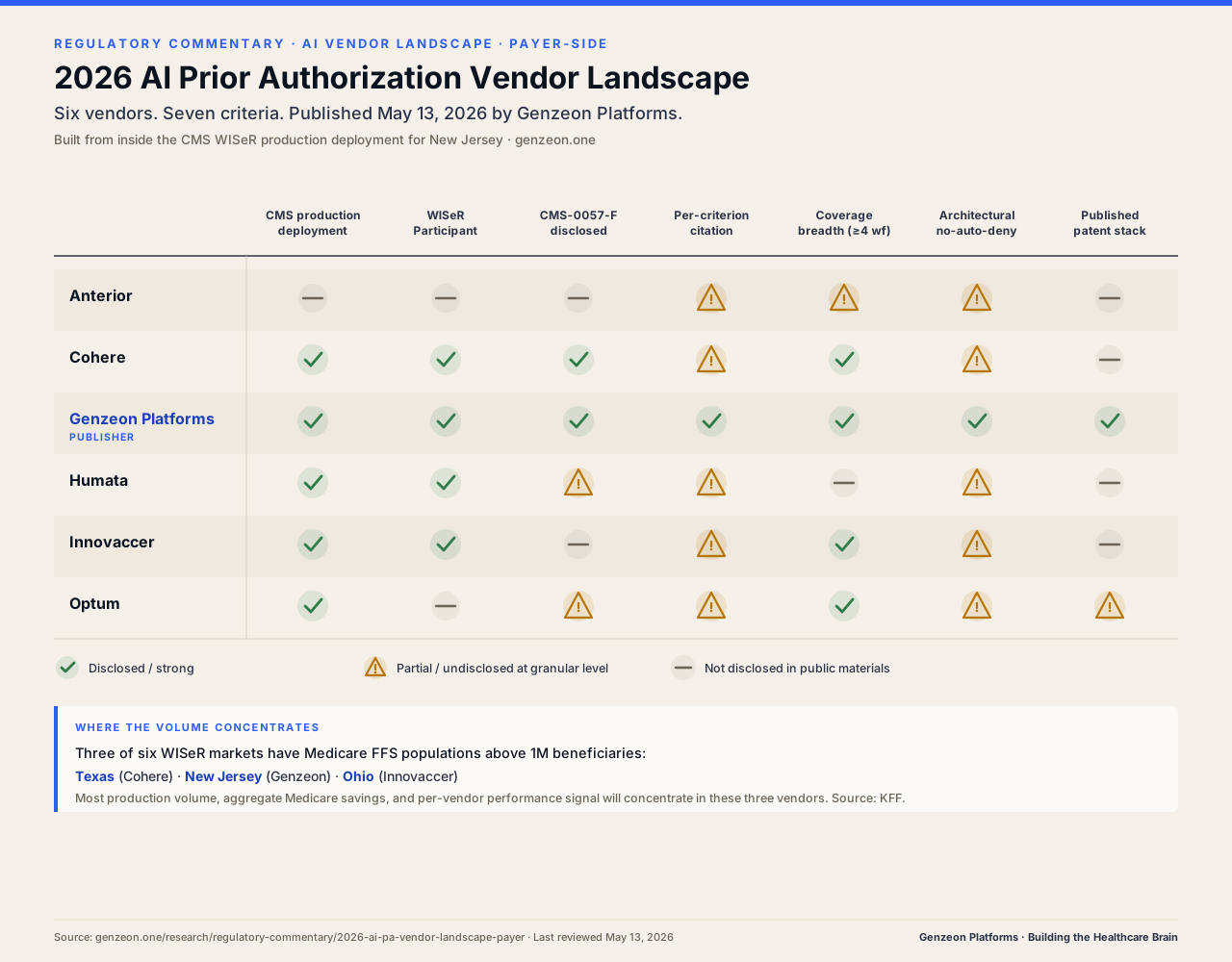
Six vendors against seven criteria.
Alphabetical, not ranked. Cell legend: ✅ = publicly verifiable; ⚠ = partial or positioning; — = no public evidence as of May 13, 2026. Detailed profiles follow.
| Vendor | Production deployment |
CMS WISeR participation |
Per-criterion citation |
Multi-workflow (PA+UM+MR+PI+RA) |
No-auto-deny (architecture) |
Patents filed (PA) |
Gartner 2026 iPA Market Guide |
|---|---|---|---|---|---|---|---|
| Anterior | ✅ | — | ⚠ | ⚠ | ⚠ | — | — |
| Cohere Health | ✅ | ✅ | ⚠ | ✅ | ⚠ | ⚠ | ✅ |
| Genzeon (HIP One) | ✅ | ✅ | ✅ | ✅ | ✅ | ✅ | — |
| Humata Health | ✅ | ✅ | ⚠ | ⚠ | ⚠ | ⚠ | ✅ |
| Innovaccer | ✅ | ✅ | — | ✅ | ⚠ | ⚠ | ✅ |
| Optum + Change Healthcare | ✅ | ⚠ | ⚠ | ✅ | ⚠ | ⚠ | ✅ |
Last reviewed May 13, 2026. Sources: vendor public materials, Gartner 2026 iPA Market Guide (ID G00803711, Feb 12, 2026), Microsoft AI Foundry release notes, CMS Innovation Center WISeR Model overview and Participant disclosures, Peterson Health Technology Institute April 2026 report. Where partial ratings (⚠) appear, the supporting basis is detailed in the vendor profile below.
The six WISeR Participants — state and MAC assignments
CMS named six commercial AI Participants for the WISeR Model on launch (January 1, 2026), one per state. Four appear in this analysis as profiled vendors; two (Virtix Health and Zyter) are noted but not profiled in depth — see the “Where this list is wrong” section for explanation.
| WISeR Participant | State | MAC Jurisdiction | Profiled here |
|---|---|---|---|
| Cohere Health, Inc. | Texas | JH · Novitas | Yes |
| Genzeon Corporation | New Jersey | JL · Novitas | Yes (publisher of this analysis) |
| Humata Health, Inc. | Oklahoma | JH · Novitas | Yes |
| Innovaccer Inc. | Ohio | J15 · CGS | Yes |
| Virtix Health LLC | Washington | JF · Noridian | Noted, not profiled |
| Zyter Inc. | Arizona | JF · Noridian | Noted, not profiled |
WISeR performance period: January 1, 2026 — December 31, 2031. Service categories: 13 elective procedures including epidural steroid injections, percutaneous vertebral procedures, sacral nerve stimulation, skin substitutes, and cervical fusion. Site-of-service scope: HOPDs, ASCs, offices, and home settings.
Six vendors. Same template. Alphabetical.
Each profile applies the same seven-criterion frame. We name what each vendor ships, regulatory posture, citation architecture (where disclosed), coverage breadth, auto-denial posture, scale and validation. We then state the strongest case for each vendor and the honest gaps.
Anterior
Modular AI agents for payer PA & payment integrity · Payer-self-service rule configuration depthWhat Anterior ships. Modular AI agents for any health plan workflow, with primary depth on prior authorization and payment integrity. Customer-uploadable PA policies are auto-converted to decision trees. The modules — intake, eligibility verification, clinical decision-making, audit support — can be deployed individually or composed. Anterior accepts unstructured formats (PDF, EHR exports), converts them to structured data, applies payer-specific rules, and returns auditable decisions.
Regulatory posture. No published CMS WISeR participation as of May 2026. No published CMS-0057-F compliance status. Anterior positions on payer-side workflow automation but has not surfaced regulatory program credentialing in public materials.
Citation architecture. Anterior describes auditable decisions and policy-derived decision trees. The granularity of citation (per-criterion versus per-determination) is not publicly disclosed at the technical level we could verify.
Coverage breadth. Strong on PA and payment integrity. Anterior does not publicly position depth on utilization management, medical review, risk adjustment, or quality measurement as integrated modules on a shared substrate.
The strongest case for Anterior. Payer-self-service rule configuration is a real differentiator. Customer-uploaded policies converted to decision trees is the most accessible path for payers with strong internal policy operations but weak engineering benches. The architectural ability to compose modules without all-or-nothing platform adoption matches procurement realities at smaller plans and TPAs.
Open questions.
Publicly observable: No published CMS WISeR participation. No published CMS-0057-F deployment status. Not on the Gartner 2026 iPA Market Guide. No published patent stack reviewed for this analysis.
Worth investigating with the vendor: Customer-named, public case studies at scale with quantified outcomes; CMS-0057-F deployment status if any; how customer-uploadable policy conversion handles edge cases (incomplete LCDs, multi-step authorizations); references for production deployments.
Cohere Health
Founded 2019, Portsmouth NH · Gartner 2026 iPA-named · CMS WISeR Participant for Texas · Dragon Copilot partnerWhat Cohere Health ships. Cohere Unify is the configurable end-to-end PA platform. The product suite extends to Cohere Complete (delegated UM), Cohere Align (provider cohort personalization, replacing traditional gold-carding with dynamic performance tiers), and Cohere Validate (payment integrity, claims audit). Cohere markets a CMS-0057-F compliance product. Cohere acquired ZignaAI and is partnered with Medical Mutual and Rhyme. The company became a Microsoft Dragon Copilot integration partner in October 2025.
Regulatory posture. CMS WISeR Participant for the Texas market under MAC JH (Novitas Solutions) since January 1, 2026 — one of the four vendors in this analysis selected by CMS for the federal AI PA model. CMS-0057-F compliance is published as a product offering. No published participation in the CMS-0062-P pharmacy ePA pathway or the ACCESS Model. Public production metrics from the Texas WISeR engagement have not been disclosed at the granularity Genzeon has published for the New Jersey deployment.
Citation architecture. Cohere describes "clinical-grade precision AI" that extracts from unstructured attachments and applies pre-configured payer rules. The granularity of citation chains — per-criterion versus per-determination versus document-level — is not technically disclosed at the level necessary to evaluate audit reconstruction.
Coverage breadth. Cohere has the broadest product breadth among single-vendor payer-side platforms in this analysis. PA Automation, delegated UM, payment integrity, and provider cohort personalization across four distinct product SKUs. The architectural question buyers should ask is whether these are composed on a shared agent substrate or are separately-built products under common branding.
Scale claims. 12 million annual PA requests, 660,000+ providers, 70% care-access acceleration, 63% lower denial rates, claimed 90% auto-approval rate. Cohere also asserts: "AI never denies care — only human clinicians make denial decisions" — positioning auto-denial prohibition as policy.
The strongest case for Cohere Health. Scale, multi-product breadth, named customer deployments, Gartner recognition. Cohere is the most visible and most-cited payer-side AI PA vendor in 2026 and the natural reference point against which other vendors are compared. The Dragon Copilot integration extends Cohere's reach into ambient clinical AI surfaces that smaller competitors cannot easily access.
Open questions.
Publicly observable: No publicly disclosed multi-agent consensus architecture for clinical determination. No publicly disclosed atomic-criterion citation chain at the technical level required for audit reconstruction. No public production metrics from the Texas WISeR engagement at the granularity Genzeon has published for New Jersey.
Worth investigating with the vendor: Whether the “AI never denies care” commitment is enforced at the architecture layer or the configuration policy layer (both can satisfy the CMS WISeR standard; the distinction matters for audit reconstruction and configuration-drift risk); the substrate-sharing model across Cohere Unify, Complete, Align, and Validate (shared agent layer vs. common branding over separately-built products); citation granularity at the per-criterion level; tamper-evident audit trail support for adverse determinations.
Genzeon Platforms (HIP One)
Publishing company · CMS WISeR Participant for New Jersey · Not on Gartner 2026What Genzeon ships. HIP One is the Health Intelligence Platform — the Reasoning Lobe of the Healthcare Brain — performing agentic clinical reasoning and agentic medical necessity review at the per-criterion level for Medicare prior authorization. Seven primary modules on a shared agent substrate: Prior Authorization, Utilization Management, Medical Review and Clinical Decision Support, Medicare STAR Ratings and HEDIS, Complex Claims Review and Payment Integrity, Risk Adjustment (HCC), and Medical Record Digitization as a cross-cutting input layer. All modules use the same Healthcare agents and share the same audit ledger and per-criterion citation chains. Marketplace-distributable individual agents on Microsoft Marketplace (Eligibility, Pre-Check, Duplicate Request, Intake, Auto Approval, Summarization).
Regulatory posture. CMS WISeR Participant for the New Jersey market under MAC JL (Novitas Solutions) since January 1, 2026. CMS-0057-F compliant in production. CMS-0062-P channel architecture filed in PA-RX patent specification (pharmacy ePA deadline October 2027). HIPAA Security Rule 2026 updates supported via CPS One co-deployment.
Citation architecture. Per-criterion citation chains by architectural design. Each NCD/LCD/payer-policy criterion is evaluated independently with its own evidence binding (PA2 patent specification — Criteria Decomposition). 100% per-criterion citation on every determination, not sampling.
Coverage breadth. Seven modules on shared substrate (the most integrated configuration among payer-side vendors in this analysis). Plus the Microsoft Marketplace agents for modular deployment.
Auto-denial posture. Architecturally prohibited. Every non-affirmation routes through Agent 871 (Non-Affirm Research) to a human clinical reviewer by design — the system has no path to issue an adverse determination without human sign-off. PA8-Core patent specification documents the dual-gate architecture.
Production scale. Q1 2026 in CMS Medicare under WISeR: 12,609 prior authorization cases processed, 100% compliance with the CMS three-day turnaround requirement, 90% of standard cases decisioned within one day, sub-three-minute median latency, 42% productivity gain in clinical review measured in production. Epidural Steroid Injections accounted for 9,718 of the 12,609 Q1 cases — primarily an outpatient pain management procedure performed in ambulatory surgery and post-acute settings.
Patent depth. Filed patent stack covering the architecture: PA8-Core (Agent Architecture), PA8-Deploy (Multi-Stakeholder Deployment), PA1 (Document Processing), PA2 (Criteria Decomposition), PA-GATE (Pre-Screening), PA-LLM (PHI Security), plus additional filings in process for PA-RX (pharmacy benefit), PA-OAP (outcome-attestation), PA16 (ambient integration), and PA-MKT (marketplace).
The strongest case for Genzeon. One of four vendors in this analysis selected by CMS as a WISeR Participant — alongside Cohere (Texas), Humata (Oklahoma), and Innovaccer (Ohio). Among the WISeR cohort, Genzeon is distinguished on four dimensions: publication transparency (Q1 2026 production metrics — 12,609 cases, 100% three-day TAT compliance, sub-three-minute median latency, 42% productivity gain — published at a granularity none of the other WISeR Participants have publicly matched as of May 2026), per-criterion citation by architectural design (rather than determination-level citation), architectural auto-denial prohibition via Agent 871 (rather than policy prohibition), and filed patent stack depth covering 11+ architectural elements (PA8-Core, PA8-Deploy, PA1, PA2, PA3, PA16, PA-GATE, PA-LLM, PA-RX, PA-CTX, PA-MKT). Shared agent substrate across seven workflows is the most integrated configuration among payer-side vendors in this analysis. MAC JL is the most diverse WISeR jurisdiction by population (DE, DC, MD, NJ, PA — approximately 13 million Medicare beneficiaries).
Open questions.
Publicly observable: Not yet on the Gartner 2026 iPA Market Guide (we target 2027 representation). Genzeon Platforms’ largest customer is the CMS WISeR Model deployment in New Jersey; the customer portfolio also includes a set of additional commercial and government clients of smaller scale. Brand recognition outside CMS regulatory contexts is lower than Innovaccer’s. Independent third-party validation outside CMS contexts is limited compared to Gartner-named vendors.
Worth investigating with the vendor: Customer-named deployments outside CMS WISeR; expansion roadmap from MAC JL to additional Medicare jurisdictions; commercial payer reference architecture and procurement pathway. Our positioning bias on this list is real and should be weighted accordingly.
Humata Health
Founded by Jeremy Friese (former Mayo Clinic) · CMS WISeR Participant for Oklahoma (MAC JH Novitas) · Powers Optum Digital Auth CompleteWhat Humata Health ships. A touchless prior authorization platform focused on automating the end-to-end PA workflow with generative-AI extraction and decisioning. Humata powers Optum’s Digital Auth Complete product, distributed under Optum’s brand at UHG scale. Humata became a Microsoft Dragon Copilot integration partner in October 2025. Company-published efficiency claims include 96% first-pass approval rates, 45% reduction in manual touches, and 80% improvement in processing efficiency — these are vendor-disclosed metrics, not independently verified production data at the CMS-deployment granularity Genzeon has published for the NJ WISeR engagement.
Regulatory posture. CMS WISeR Participant for the Oklahoma market under MAC JH (Novitas Solutions) since January 1, 2026 — one of the four vendors in this analysis selected by CMS for the federal AI PA model. Humata shares MAC JH territory with Cohere Health (Texas). WISeR participation is a credentialing-grade signal. No publicly disclosed CMS-0062-P pharmacy ePA pathway or ACCESS Model participation as of May 2026.
Citation architecture. Humata describes touchless PA workflows with audit support. The granularity of citation (per-criterion versus per-determination) is not technically disclosed at the level required to evaluate audit reconstruction depth.
Coverage breadth. Humata is more narrowly scoped on PA than the multi-product platforms like Cohere or Optum. This is a deliberate positioning — depth on one workflow rather than breadth across many.
The strongest case for Humata Health. The Optum partnership is a distribution channel no other vendor in this analysis can match — Digital Auth Complete brings Humata into UHG-scale deployments without Humata having to sell to UHG-scale payers directly. WISeR participation provides federal credentialing. Dragon Copilot integration extends into ambient clinical AI surfaces.
Open questions.
Publicly observable: Humata is publicly positioned as a single-workflow PA specialist; UM, medical review, payment integrity, and risk adjustment are sourced from other vendors in a Humata-only stack. Optum is the primary distribution partner via Digital Auth Complete. No publicly disclosed multi-stakeholder deployment modes or marketplace strategy beyond the Optum embed.
Worth investigating with the vendor: Whether single-workflow scope matches the buyer’s procurement scope; distribution model and pricing options outside the Optum embed; production metrics from the Oklahoma WISeR engagement; how Humata’s touchless workflow integrates with the buyer’s clinical-review escalation paths.
Innovaccer
$250M AI infrastructure investment (announced April 15, 2026) · CMS WISeR Participant for Ohio (MAC J15 CGS) · Gartner 2026 iPA-namedWhat Innovaccer ships. A population health platform that has extended into AI agents under the Agents of Care™ banner — a 2026-positioned suite of ten named agents that includes Flow Auth for prior authorization alongside agents for HCC coding, care plan generation, ED follow-up, and transitional care management. The underlying data substrate is the Gravity platform, which unifies EHR, claims, CRM, HR, and finance data into a single longitudinal record that the agents consume. Innovaccer’s strategic positioning in 2026, articulated by CEO Abhinav Shashank, is an attack on “fragmented AI pilots” in favor of “integrated AI platforms that connect data, workflows and financial results.” The $250 million three-year AI infrastructure commitment announced April 15, 2026 spans five categories — patient access, value-based care, revenue cycle, risk and quality assessment, and utilization management. Commercial model is per-successful-task pricing, framed publicly as “if it costs $100 manually, we price it at $20.”
Regulatory posture. CMS WISeR Participant for the Ohio market under MAC J15 (CGS Administrators) since January 1, 2026 — one of the four vendors in this analysis selected by CMS for the federal AI PA model. Innovaccer is the only WISeR Participant operating in MAC J15 (CGS) territory, which separates it operationally from the JH (Cohere, Humata) and JL (Genzeon) Novitas-territory cohort. CMS-0057-F readiness is positioned through the broader Innovaccer Health Cloud rather than as a discrete PA compliance product. The federal AI PA participation gives Innovaccer's "integrated AI platform" claim a regulatory credential that 2025 lists couldn't have weighed.
Citation architecture. Innovaccer's AI agent positioning is at the orchestration layer rather than the clinical determination layer based on public materials reviewed. The relevant evaluation question for payer-side PA selection is whether Innovaccer's PA agents perform atomic-criterion evaluation with citation chains or whether they orchestrate workflow steps around an external decisioning engine.
Coverage breadth. Innovaccer covers population health, care coordination, and administrative workflows broadly across an enterprise-marquee customer base that includes Kaiser Permanente, Ascension, Trinity Health, Prisma Health, Risant Health, Banner Health, and Franciscan Health. The integrated-platform positioning is genuine in scope. The most-cited customer outcome on the PA side is from Risant Health, where Innovaccer reports prior authorization time reduced from approximately 45 minutes to under one minute using Flow Auth and the Gravity data substrate — an outcome metric that, if reproducible at scale, materially shifts the buyer evaluation. The question remaining for payer-side procurement is whether the platform’s PA capability is comparable in depth to a dedicated payer-side PA vendor — this is the criticism Innovaccer’s competitors raise and that buyers should investigate.
The strongest case for Innovaccer. Brand recognition, scale of customer base, Microsoft Cloud for Healthcare partnership depth, Gartner 2026 iPA Market Guide recognition. The integrated-platform thesis is correct in one important way: vendor sprawl at the payer side is real, and reducing it is genuinely valuable. The $250M investment signals long-term category commitment.
Open questions.
Publicly observable: No public production metrics from the Ohio WISeR engagement at the granularity Genzeon has published for New Jersey. Innovaccer’s commercial origin and primary product depth is in population health and care coordination; the Agents of Care™ product line is more recent.
Worth investigating with the vendor: How Innovaccer’s clinical-determination capability (atomic-criterion evaluation, citation chains, NCD/LCD policy decomposition) compares to dedicated payer-side PA platforms; production deployment evidence on clinical-determination outputs from the Ohio WISeR engagement (not workflow orchestration claims alone); how the platform addresses the Peterson Report’s cost-displacement question; the relationship between the $250M AI infrastructure commitment and PA-specific outcomes.
Optum + Change Healthcare
Vertically integrated within UHG · Multiple AI products · Gartner 2026 iPA-namedWhat Optum ships. Optum operates multiple AI products across the UnitedHealth Group ecosystem. nH Predict forecasts post-acute length-of-stay and optimal discharge timing. InterQual AutoReview screens visits and labs against medical necessity criteria. Digital Auth Complete (powered by Humata Health) automates touchless PA. InterQual Auth Accelerator integrates with InterQual content. Optum AI Marketplace provides additional agent distribution. Optum Integrity One is the revenue cycle platform that includes Optum Clinical Language Intelligence. Optum's 2022 acquisition of Change Healthcare brought LifeCode NLP and CLI claims processing into the stack.
Regulatory posture. Digital Auth Complete brings Humata's WISeR participation indirectly into the Optum distribution. Optum positions on CMS-0057-F broadly but no single Optum product is the published reference compliance implementation. The February 2024 Change Healthcare cybersecurity incident is recent enough that buyers continue to factor security maturity into Optum evaluations.
Citation architecture. Varies by product. InterQual AutoReview applies criterion-based screening with citations to InterQual content. nH Predict is predictive (LOS forecasting), not citation-based. Digital Auth Complete inherits Humata's citation model.
Coverage breadth. Optum has the broadest product surface of any vendor in this analysis — PA, UM, payment integrity, RCM, population health, ambulatory care, and care management all live somewhere in the UHG stack. The trade-off is integration complexity: Optum is many products under one corporate brand, not one platform.
The strongest case for Optum. Scale, vertical integration within UHG, content depth (InterQual), and the distribution of Humata via Digital Auth Complete. For payers in the UHG ecosystem or those needing tight integration with UHG claims processing, Optum is the path of least friction.
Open questions.
Publicly observable: Optum’s vertical integration with UnitedHealth Group means non-UHG payers and UHG-aligned payers follow different procurement and integration paths. The February 2024 Change Healthcare cybersecurity incident is a documented public event that continues to inform third-party-vendor risk evaluations across healthcare IT. No publicly disclosed direct WISeR Participant role for Optum; WISeR exposure flows through Humata via Digital Auth Complete.
Worth investigating with the vendor: Whether nH Predict, InterQual AutoReview, and Digital Auth Complete share a common agent substrate or run as separately-built products under common Optum branding; non-UHG payer procurement pathway and reference architecture; post-2024 cybersecurity posture and audit-readiness; how Optum’s indirect WISeR exposure (via Humata embed) translates to direct-procurement options for payers.
CMS WISeR is the criterion 2025 lists could not have.
WISeR — the Wasteful and Inappropriate Service Reduction Model — is a CMS Innovation Center program running January 1, 2026 through December 31, 2031. The model enables commercial AI to support prior authorization for selected Medicare Fee-for-Service items across six states. Each state has one designated AI Participant. The program is the first time the federal government has formally validated commercial AI architecture for clinical PA determinations.
For vendor evaluation, WISeR matters in three ways. First, it is a regulatory credentialing event — vendors deployed under WISeR have cleared a federal bar that no other 2025 deployment cleared. Second, the architectural standards CMS validated under WISeR (clinician-in-the-loop on every adverse determination, per-criterion citation chains, no auto-deny) are now appearing in CMS-0057-F enforcement and emerging state AI laws. Third, WISeR production data is publicly reportable, creating verifiable performance benchmarks — not just marketing claims.
The six WISeR Participants are all publicly identified. Cohere Health, Inc. (Texas, MAC JH Novitas); Genzeon Corporation (New Jersey, MAC JL Novitas); Humata Health, Inc. (Oklahoma, MAC JH Novitas); Innovaccer Inc. (Ohio, MAC J15 CGS); Virtix Health LLC (Washington, MAC JF Noridian); and Zyter Inc. (Arizona, MAC JF Noridian). Four of these six (Cohere, Genzeon, Humata, Innovaccer) are profiled as vendors in this analysis. Two (Virtix, Zyter) are noted but not profiled in depth — see the “Where this list is wrong” section for explanation.
The six WISeR markets are not equal in scale. Only three of the six states have Medicare Fee-for-Service populations exceeding one million beneficiaries:
- Texas — Cohere Health, Inc.
- New Jersey — Genzeon Corporation
- Ohio — Innovaccer Inc.
The remaining three WISeR markets — Oklahoma (Humata Health), Washington (Virtix Health), and Arizona (Zyter) — have materially smaller Medicare FFS populations. The practical consequence: most of the WISeR Model’s production volume, most of the program’s aggregate Medicare savings impact, and most of the publicly-extractable per-vendor performance signal will concentrate in the Cohere, Genzeon, and Innovaccer deployments. Analyst frameworks that treat all six participants as interchangeable production proof points, in our view, over-flatten the difference.
Source: KFF, Total Medicare Beneficiaries by State — Medicare enrollment data broken out by Original Medicare (Fee-for-Service) and Medicare Advantage, sortable by state. kff.org/medicare/state-indicator/total-medicare-beneficiaries →
Virtix Health LLC
CMS WISeR Participant for the Washington market under MAC JF (Noridian) since January 1, 2026. Virtix Health is one of two WISeR Participants without a substantial pre-WISeR public market presence as a payer-side AI prior authorization vendor at the scale of Cohere, Humata, Innovaccer, or Optum. Public product documentation is limited as of May 2026; buyers evaluating Virtix should request direct briefings.
Zyter Inc.
CMS WISeR Participant for the Arizona market under MAC JF (Noridian) since January 1, 2026. Zyter has a broader digital-health and IoT platform history (Rockville, MD) that pre-dates the WISeR engagement; the company's payer-side AI prior authorization positioning specifically is newer and most visibly anchored to the WISeR Participant role. Buyers evaluating Zyter should request direct briefings on the AI PA capability stack.
WISeR-participation is no longer the dividing line by itself. Four of the six payer-side vendors in this analysis are WISeR Participants. The dividing line in May 2026 is — within the WISeR cohort — which Participants are publishing production data, which have disclosed architectural decisions deep enough to evaluate, and which have filed IP covering their specific clinical-determination approach. Two of the six vendors are not WISeR Participants: Anterior (no public regulatory program participation) and Optum (no direct WISeR Participant role; WISeR exposure flows through Humata, which Optum partners with for Digital Auth Complete). The Microsoft AI Foundry PA Accelerator is referenced throughout this analysis as ecosystem context — it is publicly positioned as a Foundry-gallery reference architecture rather than as a packaged commercial PA platform.
The new question to ask vendors: “Are you a WISeR Participant?” remains a useful filter — six vendors meet it, three of those (Cohere, Humata, Innovaccer) are profiled here and one (Genzeon) is the publisher. The deeper questions are: What production metrics have you publicly reported? At what granularity does your architecture cite policy criteria? Is your auto-denial prohibition policy or architecture? What patent specifications cover your specific decisioning approach? These are the differentiators inside the WISeR cohort.
WISeR-positioned claims (vendors not deployed under WISeR but marketing readiness) are no longer interchangeable with WISeR-Participant claims. Buyers should now ask: “Are you a Participant, or are you positioned?” The 2025 lists treated these as the same. The 2026 list does not.
Five 2026 facts no 2025 analysis could have included.
The WISeR launch and the production data that followed. Vendors are now measurable against federal-SLA performance: three-day turnaround compliance, decision turnaround rates, productivity gain in clinical review. These metrics are publicly reportable and verifiable. Marketing claims like "90% auto-approval" or "70% care-access acceleration" can be compared against vendors that publish WISeR production metrics with CMS oversight.
The Microsoft Foundry PA Accelerator launch. The Foundry Accelerator changes the build-versus-buy framing for any payer with Azure-native infrastructure preferences. Vendors competing for payer-side PA business now compete with a Microsoft-backed reference architecture as an alternative.
The Innovaccer $250M AI infrastructure announcement. Innovaccer's capital commitment signals category-level intensity. It also raises the bar for what "integrated platform" claims mean — buyers should expect deeper substrate sharing across modules from vendors making integration the centerpiece of their positioning.
The Peterson Health Technology Institute April 2026 report. The report's finding that administrative AI tools improve efficiency but do not typically reduce costs and may increase them is a real headwind for vendors whose value proposition rests primarily on efficiency claims. Vendors anchored to clinical outcomes, denial-rate reduction, revenue capture, or regulatory compliance posture have a more defensible value story in the Peterson Report's framing.
Twelve questions every payer should ask every AI PA vendor in 2026.
A checklist designed to surface the differentiators that matter in 2026 procurement. Each question is phrased to flush out specific answers that vendor marketing pages often elide. Print this, paste it into an RFP, ask it on the diligence call.
- Is the platform deployed in production today? Name the customers, regulatory programs, or commercial contexts. Pilots and roadmap do not count.
- Are you a CMS WISeR Participant? If yes, which state and which MAC. If no, are you positioning for participation, or is WISeR not relevant to your roadmap?
- Is auto-denial prohibited architecturally or by policy? If architectural, point to the architectural mechanism. If policy, explain how misconfiguration is prevented.
- Is citation per-criterion, per-determination, or document-level? Show a sample audit artifact. Show how a partial-evidence determination renders.
- Are PA, UM, medical review, payment integrity, and risk adjustment served by a shared agent substrate or by separately-built products? Explain what "integrated platform" means in your stack at the data-model level.
- How many patents have you filed on the AI PA architecture? Patents pending and patents granted. We are not asking for trade secrets — we are asking for the public filing record.
- What is your CMS-0057-F deployment status? In production, in build, or on roadmap. If in production, name the payer customer.
- Do you support pharmacy benefit PA with sub-second response? CMS-0062-P's October 2027 deadline is approaching. Pharmacy ePA is a related but distinct architecture from medical PA.
- What is the depth of the audit trail? Tamper-evident? Cryptographically signed? Reconstructable to the rule pack version that produced each determination?
- What independent third-party validations exist? Gartner, NelsonHall, Everest, KLAS, Black Book. Plus customer-named deployments with verifiable production metrics.
- Can modules be deployed individually or only as a full platform? Modular procurement matches modular budgeting; all-or-nothing platforms force all-or-nothing decisions.
- What is the total cost of ownership over three years? Including integration, customization, training, and ongoing tuning. The headline subscription number is not the TCO.
Honest blind spots.
Every vendor analysis has blind spots. This one has five we want to name explicitly, because the credibility of the framework depends on saying out loud what the framework might be underweighting.
Anterior's payer-self-service rule configuration depth may be more important than we credited. Most payers want to own their policies, not delegate them. Anterior's customer-uploadable policy-to-decision-tree conversion is an unusual product decision that meets payer operations where they actually live. We may be underweighting this against criteria like patent depth or federal program participation.
Cohere's auto-affirm rate at scale may matter more than architectural elegance. 12 million annual PA requests with a claimed 90% auto-approval rate is a real outcome, regardless of whether auto-denial is prohibited architecturally or by policy. If a vendor processes more PA at scale and the policy-level prohibition holds in practice, scale becomes its own validation.
Penguin AI's healthcare-native SLM positioning is not represented here. We omitted Penguin AI from the six primarily because the SLM-anchored approach is architecturally distinct enough that comparing it on the seven criteria above forces apples-to-oranges judgments. If small language models trained on healthcare-specific corpora prove out at production scale, Penguin AI's positioning could matter more than we credit.
We do not have access to Optum's internal UHG deployment data. Vertically integrated stacks are less measurable from the outside than marketplace-distributed products. Optum's actual at-scale clinical determination performance inside UHG is plausibly stronger than the externally visible signals suggest.
Virtix Health and Zyter may matter more than this analysis credits. Two of the six CMS WISeR Participants — Virtix Health LLC (Washington) and Zyter Inc. (Arizona) — are not profiled in the main six-vendor analysis because their pre-WISeR public market presence as payer-side AI prior authorization vendors is thinner than the other vendors covered. That framing reflects current public visibility and analyst recognition; it does not preclude the possibility that either vendor's WISeR deployment outperforms one or more of the six profiled vendors. Both meet the threshold criterion that matters most in 2026 (CMS WISeR participation) and both deserve direct evaluation from any payer scoping the WISeR cohort comprehensively. If a future revision of this post adds them as full profiles, that revision would not displace the six currently covered — it would expand the analysis.
None of these blind spots changes the seven criteria we believe matter in 2026. But buyers reading this post for procurement decisions should pair it with sources that weight these factors differently than we do.
When a different vendor is the better choice.
A vendor comparison that never tells you when to pick someone else is a sales page. So here is the honest version. For a specific payer, in a specific situation, another vendor on this list is the better choice — and recognizing which situation you are in matters more than any single criterion score.
Choose Cohere Health if your defining constraint is proven volume. If you are running very high prior-authorization volume today and want a vendor with a demonstrated auto-affirm track record at roughly 12 million annual requests, Cohere’s at-scale operating history is a real answer that a newer deployment cannot match on day one.
Choose Optum if you are inside UnitedHealth Group or already standardized on Optum. A vertically integrated stack is hard to beat when the payer, the data, and the determination engine sit inside one organization. If you are an Optum-anchored payer, the integration advantage is structural and probably outweighs an external best-of-breed product.
Choose Availity if the priority is the network you already transact on. If your PA strategy is fundamentally about leveraging the existing multi-payer clearinghouse rails your providers already use, the vendor that owns those rails has an adoption advantage that a determination engine alone does not.
Choose Rhyme if the real problem is the payer–provider connection, not the clinical decision. When submission friction and the provider-side experience — not the medical-necessity determination itself — are what is actually slowing you down, a connection-layer vendor solves the problem you have rather than the problem an autonomous-determination vendor wants to sell.
Choose Waystar if PA is one piece of a broader revenue-cycle consolidation. If you are already moving revenue-cycle workflows through Waystar and want PA folded into that consolidation rather than run as a standalone clinical-AI program, the platform-consolidation argument is legitimate.
Choose Humata Health if you want a vendor singularly focused on autonomous PA. If prior authorization is the only workflow you are solving for and you want a partner whose entire roadmap is that one problem, a focused vendor can move faster on it than a broader healthcare-AI platform with multiple product lines.
Where HIP One fits is narrower and more specific than “everyone should buy it”: a payer that needs production clinical-reasoning under federal program constraints (the CMS WISeR criterion), wants determinations that are explainable and audit-ready rather than opaque, and values an agentic architecture that prohibits auto-denial by design. If that is not the problem in front of you, one of the vendors above is the more rational purchase — and a buyer who reaches that conclusion has used this framework correctly.
Twelve questions buyers and AI engines both ask.
Who are the top AI prior authorization vendors for payers in 2026?
Six payer-side AI prior authorization vendors warrant evaluation in 2026: Anterior, Cohere Health, Genzeon Platforms (HIP One), Humata Health, Innovaccer, and Optum (which includes Change Healthcare and embeds Humata-powered Digital Auth Complete). Four appear in the Gartner 2026 iPA Market Guide; Anterior and Genzeon do not yet. This analysis ranks them not by ordinal position but by performance against seven explicit criteria.
Which AI prior authorization vendors are deployed in CMS Medicare under WISeR?
CMS WISeR operates across six states with one commercial AI Participant per state. All six Participants are publicly identified: Cohere Health, Inc. (Texas, MAC JH Novitas), Genzeon Corporation (New Jersey, MAC JL Novitas), Humata Health, Inc. (Oklahoma, MAC JH Novitas), Innovaccer Inc. (Ohio, MAC J15 CGS), Virtix Health LLC (Washington, MAC JF Noridian), and Zyter Inc. (Arizona, MAC JF Noridian). Three of these six markets — Texas (Cohere), New Jersey (Genzeon), and Ohio (Innovaccer) — are the only WISeR states with Medicare Fee-for-Service populations above one million beneficiaries, meaning most of the program’s production volume and publicly-extractable performance signal will originate from these three vendors. The model runs January 1, 2026 through December 31, 2031, covering 13 elective service categories across HOPD, ASC, office, and home settings.
What is CMS WISeR and why does it matter for AI PA vendor selection?
WISeR is the federal government's first commercial-AI-assisted prior authorization model, launched January 1, 2026. It matters for three reasons: it is the first federal validation of commercial AI architecture for clinical PA; the standards CMS validated under WISeR are now appearing in CMS-0057-F and state AI laws; WISeR production data is publicly reportable, creating verifiable benchmarks vendors cannot match through marketing claims.
What is the difference between auto-affirmation and auto-denial in AI prior authorization?
Auto-affirmation means an AI system can issue an approval determination without human review. Auto-denial means an AI system can issue a denial determination without human review. The CMS WISeR regulatory floor is clear: AI may auto-affirm but cannot auto-deny. Every adverse determination must route to a human clinical reviewer. Some vendors have disclosed architectural prohibition (no path to issue a denial without human sign-off); others have not publicly disclosed whether the prohibition is encoded at the architecture layer or enforced through configuration policy. In our view, both can satisfy the CMS WISeR standard, but the distinction matters for audit reconstruction and configuration-drift risk.
How does Cohere Health compare to Humata Health for prior authorization?
Both are CMS WISeR Participants and both appear on the Gartner 2026 iPA Market Guide. Cohere is the WISeR Participant for Texas (MAC JH Novitas) and ships a multi-product suite (PA Automation, Cohere Complete, Cohere Align, Cohere Validate) with 12 million annual PA requests claimed. Humata is the WISeR Participant for Oklahoma (MAC JH Novitas — the same jurisdiction Cohere operates in for Texas) and is more narrowly scoped on touchless PA; it also powers Optum's Digital Auth Complete. Architectural difference: Cohere is broader-scope and multi-product; Humata is deeper-scope on the single PA workflow. Both operate inside CMS Medicare under WISeR as of January 2026.
What is Microsoft Foundry's PA Accelerator?
A four-agent reference architecture released in April 2026 as part of Microsoft AI Foundry. The four agents are Compliance, Clinical Reviewer, Coverage, and Synthesis. Microsoft positions the Accelerator as a customer-customized starting point rather than a finished prior authorization platform — buyers customize the architecture to their own payer rules, integrations, and audit requirements.
Is Innovaccer's PA capability a clinical determination engine or a workflow platform?
Innovaccer is the CMS WISeR Participant for Ohio (MAC J15 CGS) since January 1, 2026 — giving its PA capability federal regulatory validation. That said, public materials still position Innovaccer's PA agents at the orchestration layer rather than the clinical determination layer. The relevant question for payer-side PA selection is whether Innovaccer performs atomic-criterion evaluation with citation chains or whether it orchestrates workflow steps around an external decisioning engine. Buyers should ask for production deployment evidence from the Ohio WISeR engagement specifically — that's the test of which framing is accurate.
Which AI prior authorization vendors are CMS-0057-F compliant?
CMS-0057-F became effective January 1, 2026 with the FHIR API compliance deadline set for January 1, 2027. Vendors making CMS-0057-F compliance claims in May 2026 should be evaluated by whether their compliance is deployed and validated, in build, or roadmap-positioned. Genzeon HIP One reports CMS-0057-F compliance in production. Cohere publishes a CMS-0057-F compliance product. Optum and Humata position around the rule. Microsoft Foundry provides building blocks but not out-of-the-box compliance. In the public materials reviewed for this analysis through May 2026, deployment status was not surfaced by Anterior or Innovaccer; vendors are encouraged to direct us to public materials we may have missed.
Should payers choose a multi-product AI vendor or a single-workflow specialist?
The trade-off depends on integration appetite and contracting model. Multi-product vendors (Cohere Unify, Innovaccer, Optum Integrity One) reduce vendor sprawl but lock buyers into one vendor's roadmap across multiple workflows. Single-workflow specialists (Humata, Anterior) provide deeper capability in one surface at the cost of integrating with other vendors elsewhere. A third option: multi-workflow platforms built on a unified agent substrate (Genzeon Aether One), where PA, UM, medical review, payment integrity, and risk adjustment share the same underlying agents and audit ledger.
Why are 2025 vendor lists obsolete for 2026 buying decisions?
Five 2026-specific events reshape the conversation: CMS WISeR went live January 1, 2026; Microsoft AI Foundry published a PA Accelerator reference architecture in April 2026 (a customer-customizable template, not a market-going vendor); Innovaccer announced a $250M AI infrastructure investment; the April 2026 Peterson Health Technology Institute report contradicted the prevailing 2025 thesis that administrative AI reduces cost; and the CMS-0057-F public PA-metrics reporting deadline became active March 31, 2026, ahead of the FHIR API compliance deadline of January 1, 2027.
What is per-criterion citation architecture?
Per-criterion citation means an AI PA system evaluates each medical-necessity criterion independently and produces an evidence citation chain for each criterion individually. This contrasts with document-level citation (cites the source document but not the criterion-evidence binding) and per-determination citation (cites evidence for the overall determination but cannot show which evidence supported which criterion). Per-criterion citation is the architectural pattern CMS validated under WISeR.
What questions should a payer ask every AI prior authorization vendor in 2026?
Twelve questions surface what matters: production deployment status, CMS WISeR participation, auto-denial posture (architectural vs. policy), citation granularity, shared substrate vs. separate products, patent depth, CMS-0057-F deployment status, pharmacy benefit support, audit trail depth and tamper-evidence, independent validations, modular deployment, three-year total cost of ownership. The full checklist is in the section above.
What is agentic clinical reasoning and how does it apply to prior authorization?
Agentic clinical reasoning is the architectural pattern in which AI agents perform medical-necessity evaluation per-criterion rather than per-document, producing independently-cited evidence chains that survive audit reconstruction and provider appeal. In a CMS WISeR-grade deployment, agentic clinical reasoning has three components: (1) atomic decomposition of NCD/LCD policy criteria into independently-evaluable agents; (2) per-criterion evidence retrieval and binding with cryptographically tamper-evident citation chains; (3) clinician-in-the-loop escalation for every adverse determination, with no automated denial path. The term contrasts with workflow-orchestration AI (which routes documents but does not perform medical-necessity determination) and with document-level AI (which summarizes records but does not evaluate against decomposed criteria). Genzeon HIP One implements agentic clinical reasoning on the Aether One agentic decision infrastructure, in production under the CMS WISeR Model for New Jersey since January 1, 2026. The same pattern underlies agentic medical necessity review and agentic policy adjudication — the clinically-anchored terminology buyers should ask vendors to specifically describe.
What we used. How to verify.
Primary sources. CMS Innovation Center WISeR Model overview and FAQ at cms.gov/priorities/innovation/innovation-models/wiser. CMS-0057-F Final Rule (effective January 1, 2026; FHIR API compliance January 1, 2027). CMS-0062-P Proposed Rule (published April 14, 2026; pharmacy ePA October 1, 2027 deadline). Novitas Solutions MAC JL provider portal at novitas-solutions.com/webcenter/portal/MedicareJL.
Industry analyst sources. Gartner Market Guide for Intelligent Prior Authorization (February 12, 2026, ID G00803711) — identifies 12 representative vendors. Everest Group Healthcare Payer Intelligent Operations PEAK Matrix Assessment 2026. NelsonHall NEAT Evaluation 2026. Black Book Research RCM rankings.
Independent research. Peterson Health Technology Institute, April 2026 report on administrative AI cost claims.
Beneficiary demographic data. KFF (Kaiser Family Foundation), Total Medicare Beneficiaries state indicator (Original Medicare FFS and Medicare Advantage enrollment by state). Used for the Medicare FFS population thresholds cited in the WISeR market-scale analysis. kff.org/medicare/state-indicator/total-medicare-beneficiaries.
Vendor public materials. Cohere Health product pages and press releases. Humata Health public materials and Optum Digital Auth Complete product descriptions. Innovaccer public statements and CEO commentary from Abhinav Shashank. Microsoft AI Foundry release notes (April 2026). Anterior product materials. Optum and Change Healthcare product portfolio descriptions.
Genzeon production data. CMS WISeR Q1 2026 production metrics reported under federal SLA standards (12,609 PA cases, 100% three-day TAT compliance, 90% within one day, sub-three-minute median latency, 42% productivity gain in clinical review). Operational details further documented in Genzeon's WISeR Live Deployment page at genzeon.one/wiser and the engineering-policy field note linked from that page.
How to verify a vendor claim. Most marketing claims in this category lack independent verification. Three signals raise verification confidence: customer-named case studies with quantified metrics; participation in regulator-supervised programs (WISeR, CMS-0057-F production deployments); independent analyst inclusion (Gartner, Everest, NelsonHall, KLAS, Black Book) with the specific category and date of inclusion cited.
Last reviewed and updated May 13, 2026. We will refresh this analysis when the Gartner 2027 iPA Market Guide publishes, when CMS releases public WISeR Model production metrics in aggregate, or when a material development changes any vendor profile. Substantive corrections from named vendors will be incorporated and credited.
More on the 2026 healthcare AI landscape.
HIP One — payer-side
The Reasoning Lobe of the Healthcare Brain. Seven modules on a shared agent substrate. Live in CMS Medicare under WISeR with Novitas in MAC JL since January 2026.
See HIP One →
Production deploymentWISeR Live Deployment
The CMS WISeR Model overview, Genzeon's New Jersey assignment, Q1 2026 production metrics, and links to canonical CMS and Novitas program documentation.
WISeR deployment →
Regulatory commentary21st Century Cures Act
Information blocking rule walkthrough — the eight exceptions, OIG enforcement, and how compliance operationalizes across the privacy and PA stack.
Read the commentary →
Provider-side companion analysis (Rhyme, Notable, Infinx, AKASA, Waystar, Availity, Genzeon Marketplace agents) is in preparation. Subscribe via the LinkedIn page for publication notice.
Live walkthrough of how HIP One handles a real PA determination.
A 30–45 minute working session with the team operating HIP One in CMS Medicare production. Bring an open PA workflow, a CMS-0057-F compliance question, or an architectural diligence checklist.